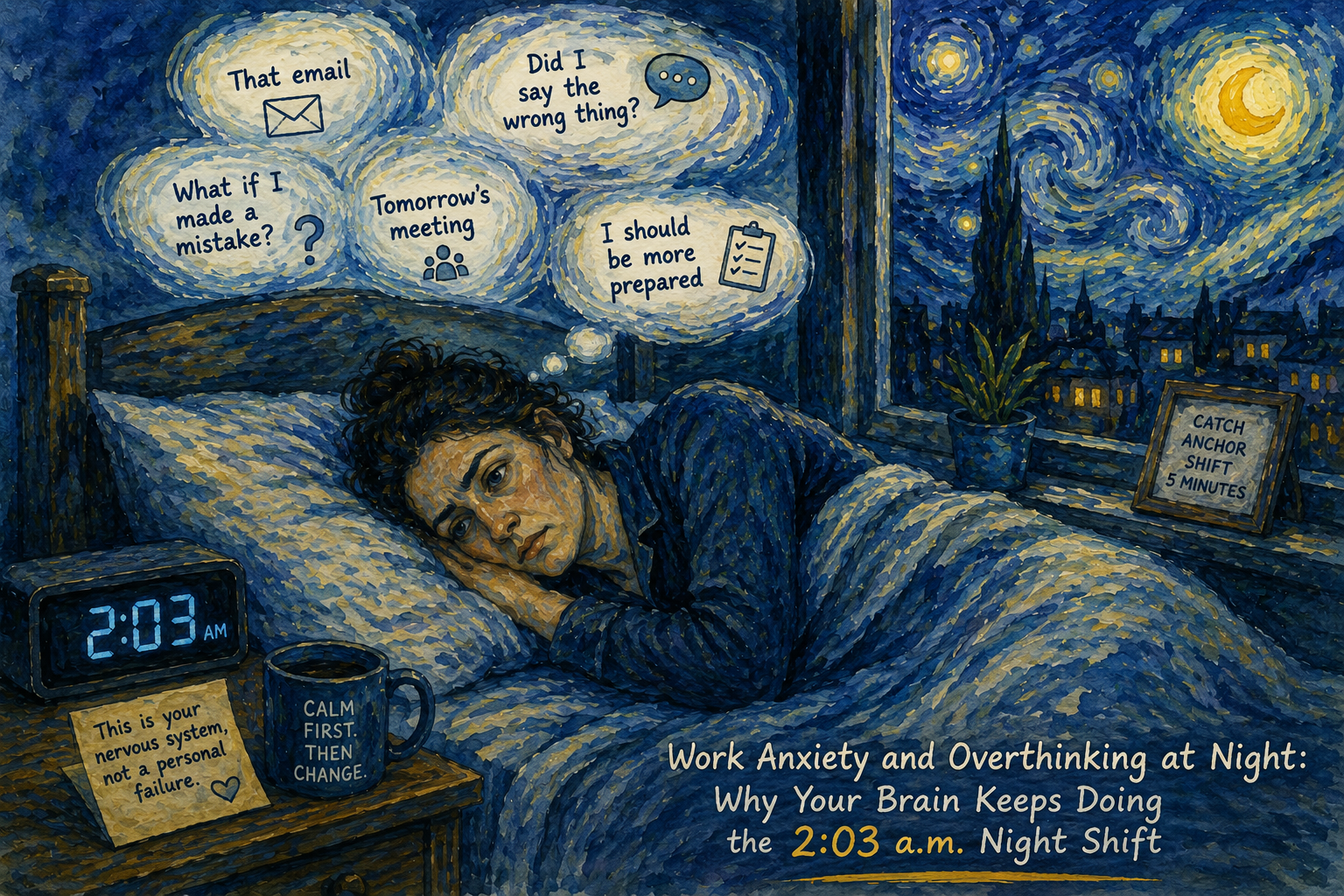
Work Anxiety and Overthinking at Night: Why Your Brain Keeps Doing the 2:03 a.m. Night Shift
Related Episode
Night Shift Overthinking | Why Work Anxiety Peaks at 2amThat Moment When Your Brain Won’t Clock Out
You know that feeling, don’t you? Your head hits the pillow. Your phone is face down. The house is quiet. And then—your brain decides now is the perfect time to open a full internal meeting that nobody asked for.
Suddenly you’re replaying the exact tone of “kind regards” in an email. You’re wondering if you said something wrong. You’re cross-examining yourself like you committed some sort of workplace treason. And somehow, sleep becomes optional while mental marathons become urgent.
If this sounds familiar, this episode is for you.
But before we go any further, let’s make something crystal clear: You are not weak. You are not broken. You are not failing at being calm.
What’s actually happening is that your nervous system is doing exactly what nervous systems are designed to do when they’ve been under pressure for far too long. It scans. It rehearses. It predicts. It tries to regain control.
The only problem? Your nervous system has absolutely no respect for business hours.
The 2:03 a.m. Brain Paradox
There’s something particularly cruel about work anxiety at night. You’re exhausted. Your body desperately wants to sleep. But mentally? You’re chairing a meeting nobody asked for.
You’re stuck in this painful loop: exhausted but alert. Tired but wired. Desperate to sleep but mentally solving problems that could absolutely wait until morning.
And then comes the shame spiral. I should be better at coping, you tell yourself. What’s wrong with me that I can’t just switch off?
Here’s what we need to understand: shame is not a sleep aid. If it were, half the country would be peacefully resting by now.
What’s actually happening isn’t a character flaw—it’s a pattern your mind and body have gotten caught in together.
The Overthinking Disguise: Why It Feels Like Responsibility
For high-achieving women especially, there’s a particular trap we fall into, and it’s sneaky.
Overthinking doesn’t feel like anxiety. It feels like being responsible. It feels thorough. It feels like you’re staying ahead of things. It feels like if you just replay the conversation one more time, or stay alert enough, you might actually prevent something from going wrong.
And that’s the trap.
Work anxiety disguises itself as preparation. It whispers, If you replay this just one more time, you’ll be safe. If you stay alert, nothing can catch you out.
But here’s the thing: while part of you thinks you’re “just thinking this through,” your nervous system hears something very different. It hears danger. It hears something’s wrong. So it keeps you awake. It keeps you alert. It keeps you in that state of activation.
Reflection vs. Rumination: The Critical Difference
There’s an important distinction we need to make here, because not all thinking is created equal.
Reflection helps you learn. It asks: What happened? What matters? What can we do next?
Rumination, on the other hand, keeps you trapped in a perpetual loop. It replays things from seventeen different angles until your jaw hurts. It creates a mental courtroom where you’re simultaneously the prosecutor, the defence, and the judge.
Reflection creates clarity. Rumination creates activation—especially at night when your brain is already tired and not at its best for complex problem-solving.
Here’s the truth: your 2 a.m. brain is not the right tool for solving real workplace issues. If anything, it magnifies them. A small uncertainty somehow becomes a catastrophe. An awkward conversation becomes evidence that you’ve ruined your entire work life.
Very traumatic. Very convincing. But not very helpful.
The First Shift: You Don’t Have to Believe Every Story
So here’s the most important shift you can make: You don’t have to believe every story your brain tells you at night.
You can respect the signal without obeying the spiral.
This is a crucial distinction. Something in you feels unsettled—that’s the signal worth respecting. But that doesn’t mean you have to immediately solve everything right now. That’s the spiral.
Instead, try this: Something in me feels unsettled rather than I must now mentally solve everything right this second.
Calm first. Problem-solving later.
The 2:03 a.m. Night Shift Reset: Name It, Anchor It, Park It
If you wake up at night unable to switch off from work, here’s a practical three-step technique you can use immediately:
Step 1: Name It
Quietly say to yourself (or out loud, if that feels right): “This is a nervous system moment.”
Not I’m being ridiculous, not here we go again, not what’s wrong with me?
Just: This is a nervous system moment.
This one sentence matters because it moves you out of self-blame and into a position of observation. You’re not the problem. You’re just noticing what’s happening.
Step 2: Anchor It
Bring your attention to your body. Place one hand on your chest or stomach—wherever feels comfortable—and take 5 long, slow, deep exhales.
Not dramatic breathing. Just gentle inhales and slightly longer exhales. Five times.
As you do this, let your shoulders drop. Even one centimeter counts.
Your nervous system learns through these small signals that there’s safety here. That’s how it works.
Step 3: Park It
Say to yourself: “Not now. I will look at this in daylight.”
If you want to, keep a notebook nearby and write one sentence: I will deal with this tomorrow. Just one line. For example: I’ll clarify that deadline with my manager or I’ll check the actual facts about that meeting.
Then close the notebook.
This tells your brain something important: I have captured that signal. You don’t need to keep shouting about it. Your nervous system can safely go back to being observant rather than activated.
Relief vs. Restoration: Playing the Long Game
Here’s another important distinction: relief and restoration aren’t the same thing.
Relief is when the spiral drops by 5%. You’re still awake, but you’re not panicking. That counts.
Restoration is where your system starts trusting that it doesn’t have to stay on alert all night. That’s built over time through repetition, clearer boundaries, better work patterns, and creating a bedroom that feels like a place of rest—not a boardroom.
We’re not aiming for perfection here. We’re aiming for a nervous system that realizes: I can rest now, and I can deal with work during work time.
That’s not laziness. That’s recovery.
The Permission You’ve Been Waiting For
Here’s what I want you to take away from this: You are allowed to rest before everything is resolved.
You are allowed to put work down. You are allowed to stop treating exhaustion as evidence that you care.
Your brain doesn’t start doing night shifts because you’re not trying hard enough. It does it because your system is trying to create safety through control. The problem is that rumination doesn’t create safety—it creates more activation.
So tonight, when work anxiety starts looping, don’t argue with it for three hours. Don’t try to control it.
Name it. Anchor it. Park it.
Because you deserve rest. Even when your mind insists on working overtime.
Ready to Reclaim Your Peace?
If this resonates with you, the full episode goes deeper into understanding your nervous system, why it behaves this way under stress, and how to build lasting patterns of rest and recovery.
Listen to the full episode now and discover more strategies for managing work anxiety and protecting your sleep.
And if you found value in this, please follow Work Stress Anxiety by ABGW and share it with someone who might benefit from these insights.
Your journey towards balance begins with the smallest of steps. Trust in your progress, no matter the pace.