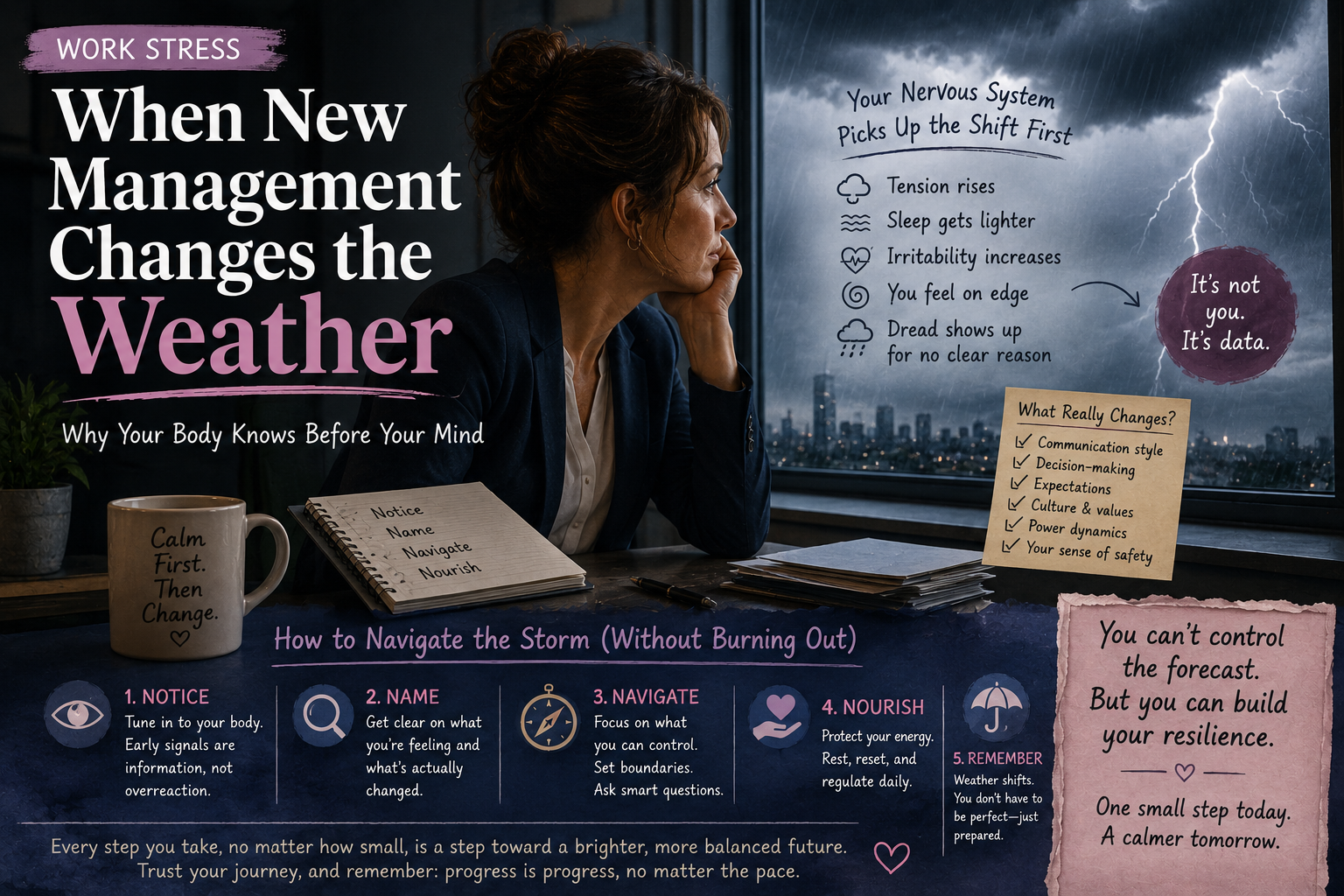
When New Management Changes the Weather: Why Your Body Knows Before Your Mind
You walk into the same office. You sit at the same desk. You open the same emails. But something feels different.
There’s no dramatic announcement. No obvious red flags. Nobody’s stroking a white cat on the corner of their desk like a pantomime villain. Yet your body is sending unmistakable signals: your stomach is churning, your shoulders have climbed up to your ears, and they seem to be applying for permanent residency there.
If new management has recently arrived at your workplace, or the team has shifted, or the tone has changed, what you’re feeling matters. Not because every change is harmful or every new manager is inherently problematic, but because your nervous system is picking up on something real—something that your conscious mind hasn’t quite found the words for yet.
The Weather Changes, But Nobody Announces It
Think of your workplace like a season. Winter, spring, summer, autumn—workplaces have seasons too. And new management can shift that season almost overnight.
When this happens, something fascinating (and frustrating) occurs: your body knows before your brain does. Your nervous system is exquisitely attuned to environmental shifts—changes in tone, energy, expectations, and safety. These aren’t imaginary feelings. They’re your system doing exactly what it’s designed to do: detecting changes in the climate around you.
The problem? Many of us, particularly high-achieving women, have been taught to override these instinctive signals. We tell ourselves we’re overreacting. We give people the benefit of the doubt until there’s barely enough doubt left to benefit us. We explain away the shift in tone, the changing expectations, the sense of being watched rather than supported. And because we’re capable—so very capable—we keep functioning. We reply to emails, we lead meetings, we smile in the kitchen, we do the work.
Then, in the car park or the bathroom, our system finally tells us the truth: something is not landing quite right here.
Nice Isn’t the Same as Safe
Here’s something crucial that often gets overlooked: a person can be pleasant and still create pressure. A manager can smile and still withhold support. Someone can be charming and still shift your role, reduce your control, and make your workplace feel unpredictable.
This is why we can’t judge by personality alone. That new manager might be lovely to your face. They might say all the right things—supportive, open door, team culture. But if the emotional climate has changed, if expectations have become unclear, if your sense of control has diminished, that’s real information. It’s not weakness to notice it. It’s your nervous system doing its job.
Equally important: the opposite is also true. Someone can be blunt, awkward, not particularly cuddly, and still be fair, clear, and genuinely supportive. Personality and safety aren’t the same thing.
The HSE Management Standards: Your Framework for Understanding
So when everything feels different after a management change, where do you start? Not with “I’m being silly,” but with a practical framework.
Work stress doesn’t only come from workload. According to the HSE (Health and Safety Executive) management standards, stress also comes from:
- Demands – Is your workload becoming less predictable?
- Control – Do you have less say in how you work?
- Support – Do you know who you can safely turn to?
- Relationships – Has the tone of interactions shifted?
- Role – Are you being asked to do things outside your job description?
- Change – Are decisions being made without clear explanation?
These aren’t random feelings. They fit neatly into a recognized framework for understanding workplace wellbeing.
The Five-Minute Reality Check
You don’t need to become a scented-candle-burning zen master here. You just need to give yourself—and your nervous system—one small signal: I am here, watching clearly.
Take five minutes. Write down those six headings: demands, control, support, relationships, role, change. Under each one, write one plain sentence describing what’s changed. For example:
- Demands: My workload feels less predictable.
- Control: I have less say in how my team works.
- Support: I don’t know who I can safely go to.
- Relationships: The tone of meetings feels colder.
- Role: I’m being asked to do things that weren’t part of my job before.
- Change: Decisions are being made without clear explanation.
This isn’t a formal grievance. It’s not legal advice. It’s not a courtroom drama. It’s simply information. It’s you, calmly, collecting reality.
Relief vs. Restoration: The Crucial Difference
Here’s where things get important. There are two very different responses to workplace uncertainty:
Relief is the moment you tell yourself, “Maybe it will all be fine,” and you push it away for another day. Sometimes that’s understandable—we all need a break from thinking sometimes.
Restoration is completely different. Restoration is when you calm your system and collect enough reality to make wise choices. You’re not solving everything today. But you’re also not making yourself the problem because you’ve actually looked at what’s changed in your environment.
This distinction matters because one keeps you stuck in self-doubt, while the other moves you toward useful clarity.
Moving From Self-Doubt to Clarity
When new management changes the weather at work, your body may notice before your brain. That’s not weakness. That’s information. And information is power.
The path forward isn’t complicated:
- Start with calm. Give your nervous system one small signal that you’re here, watching, and safe enough to think clearly.
- Name what has changed. Use the HSE framework to get specific about what’s different.
- Move from self-doubt into clarity. You’re not overreacting. You’re responding to real environmental shifts.
Your job doesn’t have to feel like constant weather changes. Your workplace doesn’t have to keep you in a state of nervous uncertainty. But recognizing what’s actually happening—rather than dismissing your instincts—is where real resilience begins.
Ready to dive deeper? Listen to the full episode of Work Stress Anxiety to explore more about navigating management transitions, understanding your nervous system’s signals, and building genuine resilience in uncertain times. Because every step you take toward clarity, no matter how small, is a step toward a brighter, more balanced future.