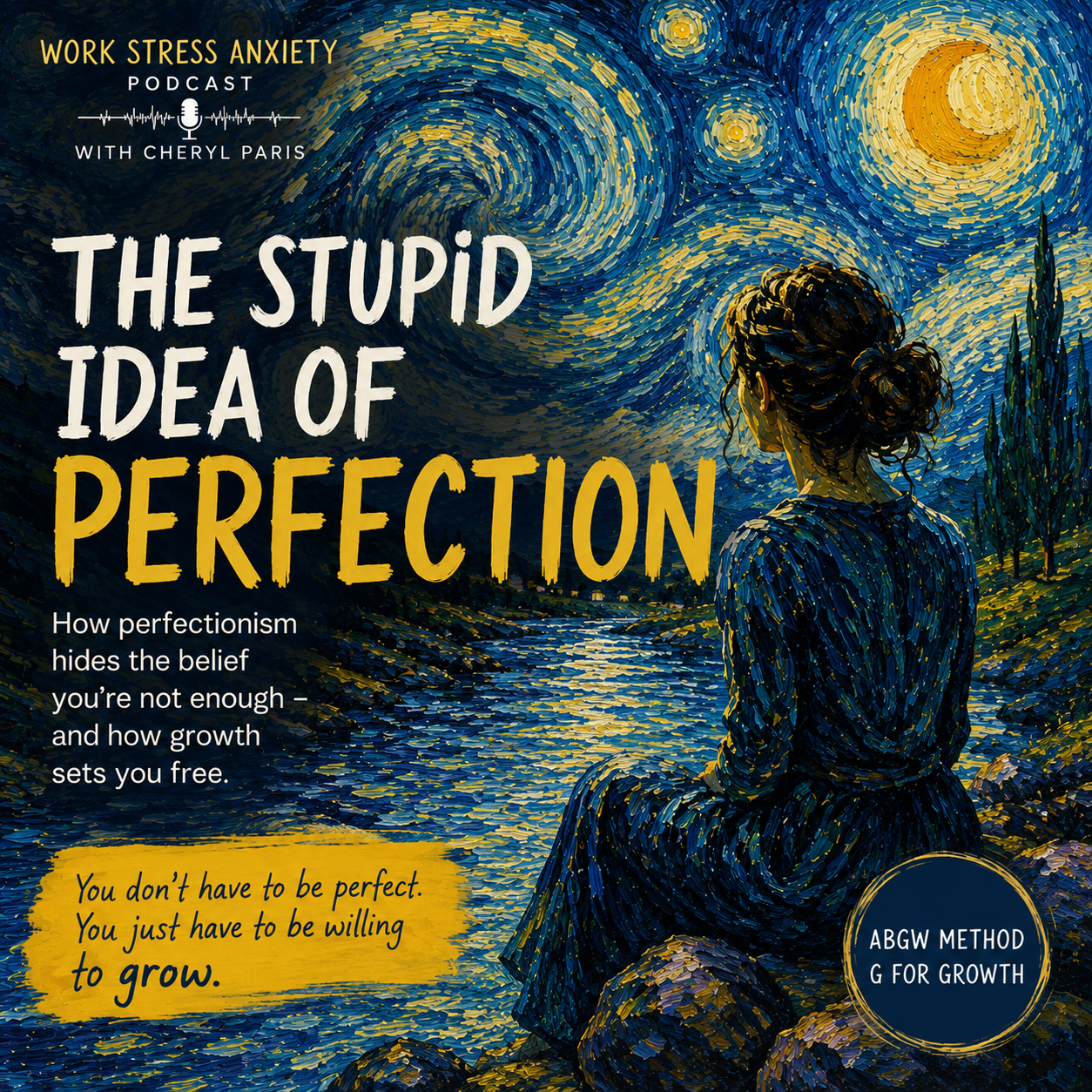
The Stupid Idea of Perfection: Why Life Isn't a Maths Exam
If you’ve ever lain awake at 2 a.m. replaying an email you sent hours ago, wondering if you could have worded it differently, you’re not alone. If you’ve felt that familiar knot of anxiety when someone reviews your work, or found yourself apologizing for things that didn’t need an apology—welcome to the perfectionism trap.
And here’s the thing: I’m going to say something that might upset a few people, but I’m going to risk it anyway.
Perfection is one of the stupidest words in the English language.
Not because excellence is stupid. Not because beautiful craftsmanship or doing your best are stupid. But because perfection doesn’t actually exist. It’s an imaginary finishing line that we invented, and then we spent generation after generation beating ourselves up for never reaching it.
The Promise That Doesn’t Deliver
Here’s what fascinates me most about perfectionism: it promises confidence, yet somehow leaves you questioning an email you’ve already sent. It whispers that if you just work harder, make fewer mistakes, or never get criticized, then—finally—you’ll be enough.
But that’s not how it works.
Think about it this way. Go outside right now. Find me one perfect tree. One perfect blade of grass. One perfectly symmetrical cloud. You can’t, because nature doesn’t produce perfection. It produces variations, growth, adaptation, and life.
Somehow, we’ve decided that human beings should achieve a standard that the natural world has never even attempted. And to me, that’s a strange contract to sign up to.
Life isn’t a maths exam with one right answer and a mark scheme. There’s no final exam where someone says, “Congratulations, you only made three mistakes—here’s your happiness.” Life is messier than that. And thankfully, it’s supposed to be.
The Real Story Behind Perfectionism
Let me confess something to you. When I recorded my very first podcast episode, I recorded it 31 times.
Not because technology failed. Not because I was creating something better with each attempt. But because anxiety had convinced me that if I just kept recording, eventually I’d make it perfect. After 31 attempts—after I’d completely lost my voice—I ended up publishing one of the very first versions.
And here’s the uncomfortable question that stopped me in my tracks: Was I trying to create a better podcast, or was I trying to prove something?
Because they’re not the same thing. Not at all.
Looking back, I didn’t want perfection. I wanted certainty. I wanted reassurance. I wanted someone to tell me I was good enough. And if you listen to those early episodes, you can hear how nervous I was. I think that’s where perfectionism really comes from—not from ambition or high standards, but from one quiet sentence that whispers in your ear:
Am I good enough?
That’s the engine underneath it all. Perfection, I think, is often just our self-doubt wearing very expensive clothes.
Moving Goalposts and Borrowed Self-Esteem
Here’s something I’ve observed in countless high-achieving women: perfectionists carry around an invisible backpack that no one else can see. Inside it are all the things they think they’ve earned—approval, acceptance, respect, love, success. Every achievement gets stuffed into that backpack.
The strange thing? It never feels any lighter.
Why? Because if you don’t believe you’re enough, no achievement is ever heavy enough to outweigh that belief. You can’t fill a hole in your self-worth with another certificate.
We’ve all met someone who said, “I’ll relax when I get that promotion.” Then they get promoted. “I’ll feel confident when I gain that qualification.” Then they finish. “I’ll finally feel successful when…” And the finish line quietly packs its bags and moves another mile down the road.
Perfectionism is brilliant at one thing and one thing alone: moving goalposts.
And here’s what’s really exhausting about this pattern—perfectionists borrow their worth. I’m good enough if people praise me. If my manager approves. If my clients are happy. If I never make a mistake. You’ve handed somebody else the keys to your self-esteem, and people are very unreliable landlords when it comes to your mind.
When you’re constantly trying to earn your worth, everything becomes a test. Dinner becomes an assessment. Your parenting becomes an assessment. Work becomes an assessment. Rest becomes an assessment. Is that living, or is that sitting in permanent examinations?
The Evidence That Changes Everything
Here’s the thought I want you to carry with you: maybe your problem isn’t that you’re not good enough. Maybe your problem is that you believed a word that was never true in the first place.
The ancient Greek philosopher Heraclitus said something over 2,000 years ago that still resonates today: “You never step into the same river twice, because it’s not the same river, and you’re not the same person.”
Think about that. The person who recorded my first episode doesn’t exist anymore. Every conversation has changed me. Every mistake has changed me. Every episode has changed me. Growth is built into life—it’s not optional.
And here’s what perfection steals: action, creativity, courage, time, joy, and—perhaps worst of all—evidence. Every time you refuse to begin until you’re perfect, you’ll never collect the proof that you were capable all along.
Confidence doesn’t arrive first. Evidence arrives first. You don’t become confident and then start. You start, and then confidence catches up with you—with every email you send, every difficult conversation you have, every mistake you recover from. You’re collecting evidence.
Three Simple Experiments to Try Today
If this resonates with you, here are three practical ways to step out of the perfectionism loop and into growth:
1. Replace “Was I good enough?” with “What did I learn?”
One question is about judgment; the other is about growth. Perfection asks for a verdict. Growth asks for a lesson.
2. Leave one thing at good enough.
Not careless—good enough. Then notice how the world keeps spinning. Notice that you’re still okay.
3. Do one unexpected act of kindness.
Something where you’re not expecting anything in return, not even a thank you. Notice how quickly your attention leaves your own inner critic and turns toward the world.
The Outrageous, Unconscious Joy
Something magical happens when you stop asking, “What do people think of me?” and start asking, “What can I give today? How can I help someone? How can I encourage someone?”
Your attention leaves that horrible mirror and turns toward the world. And that’s where joy enters the conversation—not happiness, which is fleeting, but that outrageous, unconscious joy that comes from being present, from not checking, not judging, not comparing. Just being there.
Maybe that’s why generous people always seem lighter. They’re carrying fewer mirrors.
Listen to the Full Episode
This is just the beginning of a much deeper conversation about why perfection keeps us stuck, how to build genuine confidence through imperfect action, and what it really means to be enough.
[Listen to “The Stupid Idea of Perfection: Why Life Isn’t a Maths Exam” on Work Stress Anxiety now. The full episode includes more practical strategies, real stories, and the kind of warmth and understanding you need when you’re ready to step off the perfectionism treadmill.
And if this resonates with you, please share it with a friend who’s stuck in the perfection loop. Let us know what you think by messaging us on WhatsApp at +447485622662. Your voice matters.
Where is perfectionism stealing your time right now? It’s time to find out what you’re really capable of.