The Resilience Trumpet And The Office Sandwich: Why Nice Isn't The Same As Safe
Related Episode
Quiet Toxicity At Work | High-Functioning Anxiety UnmaskedThe Uncomfortable Truth Nobody Wants to Say
Here’s something that sounds harsh until you’ve lived it: nice doesn’t always mean safe.
We’re taught to value niceness. It’s polite. It’s professional. It keeps the peace. But somewhere along the way, many of us—especially high-achieving women—have learned to confuse surface-level warmth with genuine psychological safety. And that confusion is costing us.
The quiet version of workplace stress doesn’t announce itself with shouting or obvious cruelty. It shows up in meetings where everyone speaks calmly, in smiles that don’t match the outcomes, in that slow, almost imperceptible shift in access and warmth that leaves you feeling tense, over-responsible, and constantly second-guessing your own judgment.
Nobody has been unkind. Nobody has raised their voice. So why does your nervous system feel like it’s shrinking?
That’s the question we need to answer.
The Training We’ve All Received
If you’re a high-functioning woman in the workplace, there’s a good chance you’ve been trained—directly or indirectly—to be reasonable at your own expense.
Be fair. Don’t be difficult. Stay professional. Keep the peace. Don’t make it awkward. Maybe they didn’t mean it. Maybe you should just be more resilient.
There it is: the old resilience trumpet, blaring away.
But here’s what we need to name: resilience without reality becomes self-abandonment.
You can be fair and still protect yourself. You can be compassionate and still notice patterns. You can give someone the benefit of the doubt once or twice without handing them the keys to your nervous system. These things aren’t contradictory. They’re actually the markers of real wisdom.
The problem is, we’ve been taught that noticing these patterns makes us difficult, paranoid, or unkind. So we don’t. We push down the signals our body is sending us. We rationalize. We perform. And slowly, we lose access to our own judgment.
What Safety Actually Looks Like
So if nice isn’t the measure, what is?
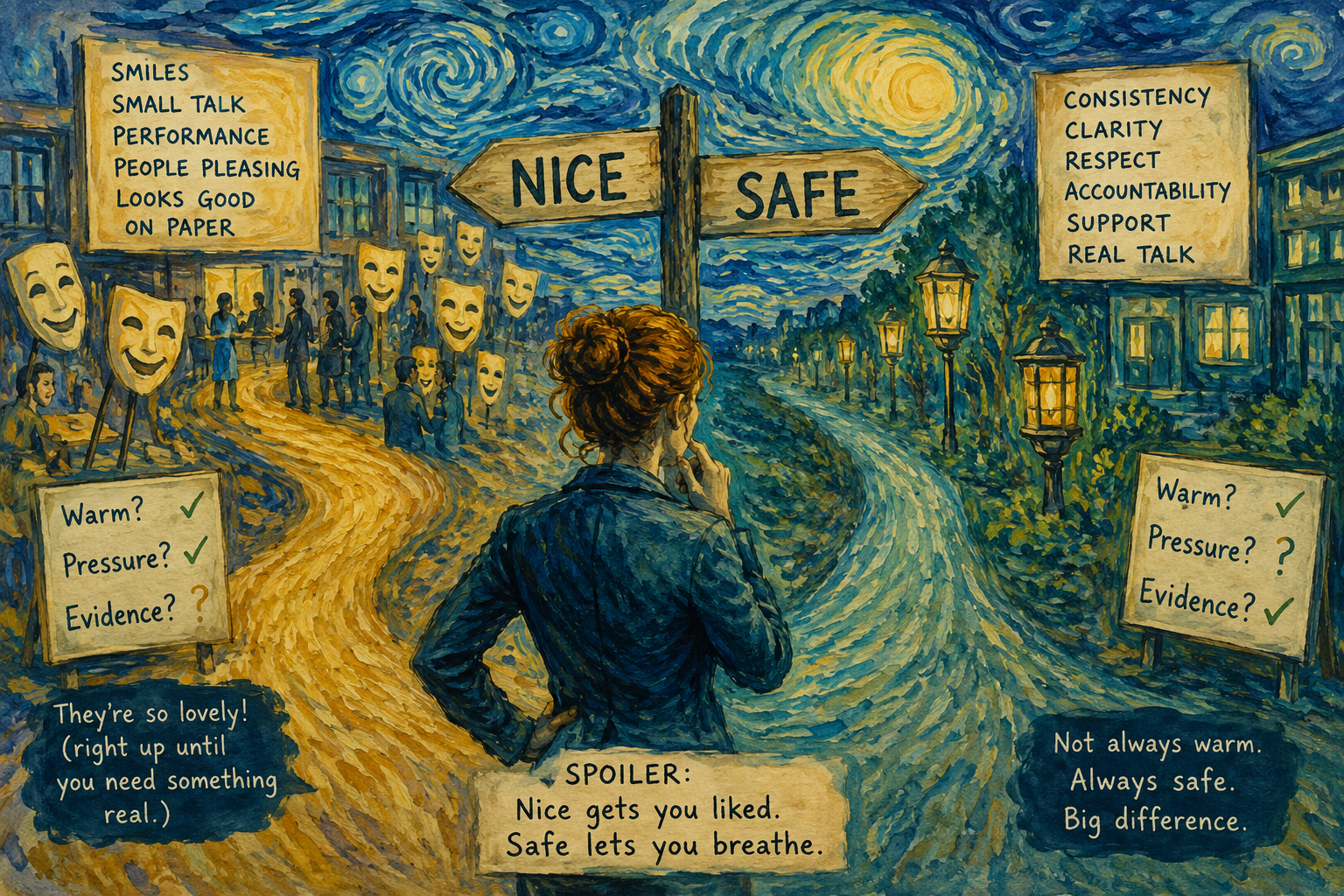
Safety has a pattern. It’s consistent. It’s clear. Safe respects your role and doesn’t punish you for asking reasonable questions. Safe doesn’t make you pay emotionally for having boundaries. Safe doesn’t require you to perform cheerfulness before you’re treated fairly.
Most importantly: safe leaves your nervous system steadier, not smaller.
When you’re in a genuinely safe environment, you can breathe. You know where you stand. You trust that people mean what they say and do what they promise. There’s room for your humanity—your questions, your concerns, your needs.
Nice, on the other hand, might be warm in the moment. But if the pattern leaves you confused, tense, over-responsible, or unsure where you stand? That’s not nice. That’s information.
Where to Look for the Real Story
The truth often shows up in three specific areas: relationships, support, and change.
Relationships: Are interactions respectful? Do people follow through? Is there consistency in how you’re treated?
Support: Is help actually available, or is it just mentioned in meetings while nothing changes? When you need something, do people show up?
Roles: Is your role clear, or does it consistently shift? Do you know what success looks like, or are you constantly guessing?
Change: When things shift in your workplace, are they explained properly? Or are you expected to absorb them with a smile while you’re dunking a biscuit into your tea?
When you look at the pattern across these areas, the real story emerges. And it’s usually much clearer than any individual interaction.
The Three-Column People Map: A Practical Tool
If you’re struggling to see the pattern clearly, try this micro-step. I call it the three-column people map, and it’s simple enough to use immediately.
Draw three columns: Warmth, Pressure, and Evidence.
Under Warmth: Write down what this person actually does to support you. Not what they say—what they do. “They want open communication” or “They celebrate my wins” or “They check in when I’m overwhelmed.”
Under Pressure: Write what happens when you’re around them that leaves you tense, small, confused, rushed, silenced, or over-explaining. “I feel anxious after one-to-ones” or “I’m unclear about expectations” or “I second-guess my decisions.”
Under Evidence: Write the plain facts. Dates if relevant. Examples. No character assassination here—just behavior and impact.
For example:
- Warmth: They say they want open communication
- Pressure: I feel anxious after my one-to-ones and unclear about expectations
- Evidence: In the last three meetings, priorities changed without written follow-up
This simple map keeps you out of the fog. It moves you from “Am I imagining this?” to “Here’s what’s actually happening.”
Keep Grounded Notes
When things are becoming uncomfortable, document it. Not obsessively, not dramatically—just grounded.
Date. Time. What happened. What was said. What changed. What impact it had. What you asked for. What response you received.
This isn’t about building a case against someone. It’s about building clarity for yourself. It’s about trusting your own reality when your brain is trying to convince you that you’re being unreasonable.
The Permission You Need
Here’s what I want you to know: people belong in different categories of access.
Some people are safe for your total honesty. Some are safe for polite work conversation. Some need boundaries, documentation, and a witness if conversations are becoming difficult.
That’s not drama. That’s discernment.
You can have both/and thinking here. Someone can have genuinely nice qualities and still not be safe with your vulnerability, your trust, your energy, or your career decisions. Both things can be true.
The goal isn’t to decide that everyone’s a villain—they’re not. The goal is to decide, based on reality and pattern, who gets access to what parts of you.
Relief vs. Restoration
Here’s one more distinction that matters: relief versus restoration.
Relief is telling yourself they’re nice, really, so it’s probably fine—because you need the discomfort to stop. It feels good in the moment.
Restoration is saying they may be nice, but I still need to look at the pattern. Restoration takes longer, but it actually heals something.
Choose restoration. Trust the pattern more than the performance.
Your Next Step
If you’ve been doubting yourself in your workplace. If you’ve felt that quiet tension in calm meetings. If you’ve wondered whether you’re being unreasonable for noticing something off—you’re not.
Your nervous system is picking up on something real. Honor that signal.
Want to go deeper into this conversation? Listen to the full episode of Work Stress Anxiety where we explore psychological safety, discernment, and how to protect your energy without abandoning your values. Subscribe now and share this with a friend who’s been second-guessing themselves.
Remember: calm first, reality first, then change. Every step you take toward clarity is a step toward a brighter, more balanced future.