Stop Making Anxiety Management a Full-Time Job: The Real Path to Workplace Calm
Related Episode
Manage Workplace Anxiety | Stop the Constant Mental WorkIf you’re a high-achieving woman navigating workplace stress, you’ve probably noticed something: managing your anxiety has become its own full-time job.
You’re monitoring your symptoms, trying breathing exercises, researching the latest wellness hack, practicing gratitude on command—all while your nervous system remains locked in high alert. The irony? All this managing is actually draining you further.
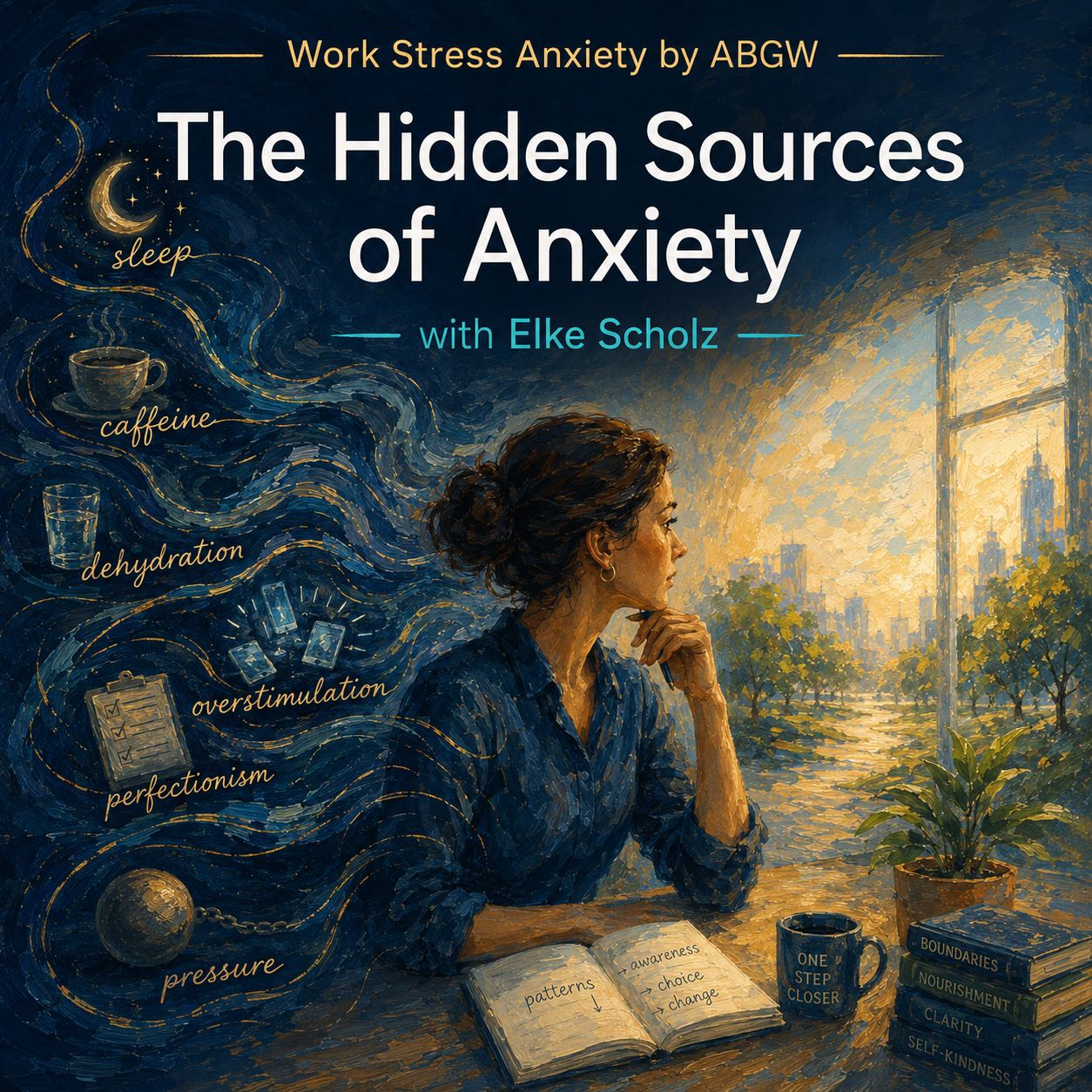
This is exactly what we explore in this episode of Work Stress Anxiety, where I sit down with psychotherapist Elke to talk about something counterintuitive: sometimes the most powerful thing you can do is stop trying so hard.
Why Anxiety Management Becomes Exhausting
Here’s what happens to many of us: we identify that we’re anxious, and then we launch into problem-solving mode. We read articles. We download apps. We create elaborate routines. We tell ourselves we should be meditating or journaling or doing yoga.
But here’s the thing—anxiety already depletes us. It exhausts our energy. And when recovering from that anxiety becomes another project we’re managing, we’re essentially adding fuel to the fire.
As Elke puts it beautifully: “Anxiety depletes us, exhaustes us. And to get that energy back, that becomes the full-time job.”
The solution isn’t more strategies. It’s not another technique to master. It’s understanding what your nervous system actually needs, and giving yourself permission to keep it simple.
Your Nervous System Speaks a Physical Language
One of the most liberating insights from this conversation is this: your body doesn’t respond to logic when it’s in panic mode.
When you’re in the grip of workplace anxiety—your heart racing, your throat tight, your stomach churning—someone telling you to “just relax and breathe” feels about as helpful as a screen door on a submarine.
This is where understanding your vagus nerve becomes game-changing.
The vagus nerve is the largest nerve running through your body. It travels from your neck, around your shoulders, behind your esophagus, and down around your stomach. And here’s why this matters: anxiety symptoms often show up as physical sensations along this pathway—tension headaches, difficulty speaking, nausea, stomach issues, racing heart.
When your vagus nerve perceives threat, it sends your whole system into protection mode. The key is giving it a different message—not with words, but with physical sensation.
The Techniques That Actually Work
This is where things get practical.
Start with the Basics
Before you try anything fancy, Elke emphasizes the fundamentals:
Water. Seriously. Make sure you have ample water with you throughout your day. This isn’t woo—it’s physiology. Dehydration amplifies anxiety symptoms.
Breathing—but realistically. When you’re already activated, the “slow deep breathing” advice often backfires. Instead, start gentler. Work with your body as it is, not as you think it should be.
Havening: The Gentle Touch Technique
Then there’s havening—a technique that sounds simple but is surprisingly powerful.
Havening involves very gently touching your hands, almost as if you’re tickling them. The physiological magic? Your vagus nerve receives a nonverbal message: “This feels nice. I’m not in danger.”
Instead of your nervous system hearing words like “relax” (which it doesn’t believe when it’s in panic), it receives a direct physical signal of safety. Your body gets it. No argument required.
Build Your Personal “Calm List”
Here’s something crucial: when you’re dysregulated, you can’t think clearly. You won’t remember what helps. You won’t be able to piece together the strategies you know work.
This is why Elke recommends creating a “calm list” in advance—whether that’s on your phone, your fridge, or your cubicle wall. When anxiety hits and your mind is spinning, you can simply look at the list and follow the steps.
Sometimes it takes layering multiple supports. You might need hydration and havening and a few minutes outside and a calming tea. That’s not failure—that’s meeting your system where it is.
The “Heavy Artillery” Approach
On particularly intense days, Elke talks about bringing out the “heavy artillery”—combining multiple supports like rescue remedy, essential oils, magnesium, breathing work, and a short break. The key is catching anxiety early, before it escalates, and starting these strategies before you even enter a stressful situation.
That client Cheryl mentions—the one who got off the tube one stop earlier to add a few minutes of walking to her commute? That’s strategic nervous system regulation. Simple. Effective. Not another job.
The Gratitude Paradox: Joy as a Byproduct
Now here’s where it gets really interesting.
Both Elke and I emphasise gratitude, but not in the toxic positivity way. Not as a cheesy slogan to plaster on your vision board.
Gratitude is attention training. It literally rewires how your brain scans for information.
Your brain can only focus on about 10 familiar things at a time (otherwise you’d go mad noticing everything). When you practice gratitude consistently, you train your brain to scan for what’s working, what’s good, what you’re grateful for—rather than defaulting to threat-scanning mode.
And here’s the kicker: when you’re genuinely grateful, you’re not anxious. These states are neurologically incompatible.
Elke shares her own journey—how it took her six months to remember what made her happy. She started small, buying comic books and reading until she laughed. She felt fake at first, but she kept practicing. And gradually, something shifted. Joy bubbled up.
This isn’t about forcing positivity. It’s about choosing where you point your attention. It’s about recognizing that perfectionism and anxiety thrive when we’re focused only on what’s wrong. But when we also acknowledge what’s right, what we’re capable of, what we’re grateful for—that’s when joy can grow.
The Real Investment
Here’s what transformed this conversation for me: Elke reframes self-care not as a chore, but as an investment.
When you invest time in your morning practice—whether that’s gratitude, hydration, gentle movement, or whatever your nervous system needs—you’re not adding to your workload. You’re actually saving time and energy. That investment ripples through your entire day, your work, your relationships.
It’s not another job. It’s the thing that makes everything else feel less like a job.
Your Permission to Keep It Simple
The most important message from this episode? You don’t need to be perfect at any of this.
Progress is progress. Small steps count. Try techniques and let go of the ones that don’t resonate. Trust your body—it knows what it needs.
You don’t need another complicated system. You need permission to listen to what actually works for you, to experiment, to keep it simple, and to recognize that the best anxiety management is the kind that doesn’t feel like management at all.
Ready to dive deeper into practical, body-based stress recovery? Listen to the full episode to hear Elke’s complete insights, discover more nervous system regulation techniques, and explore how real joy can counteract the perfectionism that drives workplace anxiety. Your calmer, more energized self is waiting on the other side of this conversation.