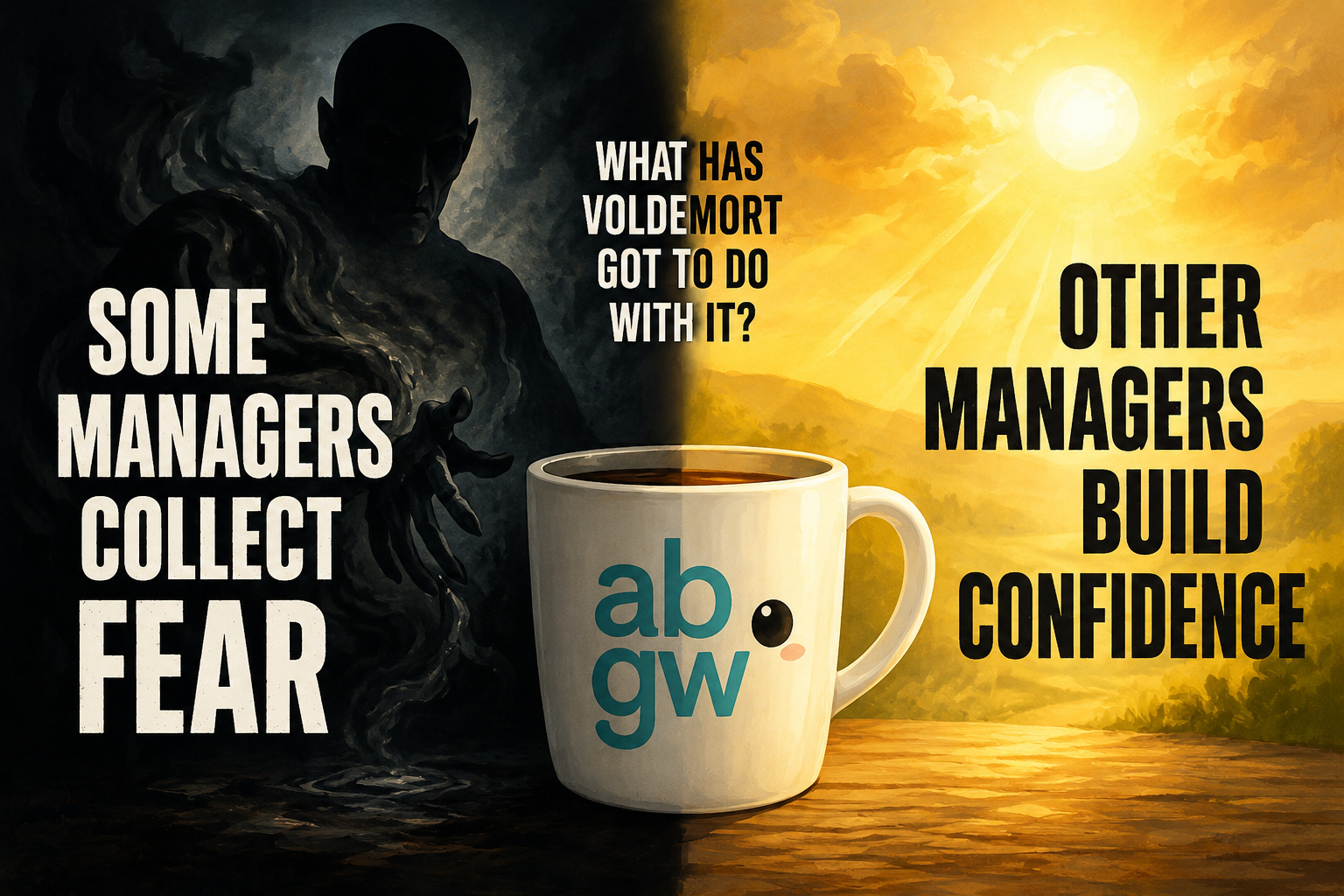
Fear-Based Leadership at Work: What Voldemort Can Teach Us About Ego, Power and the Price of Fear
Have you ever noticed that some people don’t have to say anything before the whole room changes?
One person walks through the door, conversation stops, people sit up straighter, and suddenly everyone becomes fascinated with their laptops. The room collectively holds its breath.
If this feels familiar, you’re not alone. And more importantly, what you’re experiencing isn’t weakness—it’s your nervous system doing exactly what it’s designed to do.
The Room That Shifts
Let me paint a picture for you.
It’s an ordinary afternoon at a sheltered housing scheme. Lunch has finished, residents have wandered back to their flats, and staff are chatting while waiting for the afternoon meeting to begin. The atmosphere is relaxed. People are making cups of tea, eating too many biscuits, wrestling with temperamental photocopiers. Someone’s smiling.
Today’s meeting is supposed to be good news. The organisation has agreed to invest in the building—an expansion, an in-house hairdresser, better facilities. Nothing dramatic, just practical improvements that will genuinely make life better for residents. Everyone feels quite optimistic.
Then the area manager walks in.
And everything changes.
Nobody announces it. Nobody says “here we go.” The room simply shifts. Conversations stop halfway through. People straighten their backs. Eye contact becomes optional.
One of the managers there is a lovely woman called Toni. She’s 40 years old, excellent at what she does. The residents trust her. Families ask for her. She’s the kind of manager who solves problems quietly before they become everyone else’s problems.
The meeting starts. Toni answers a question. Then she’s criticised publicly—not over something dangerous, not over poor care, not even over anything particularly significant. Something tiny. Something that could have been dealt with privately.
And that’s when something strikes us: the criticism wasn’t really about correcting a mistake. It was a performance. A reminder to everyone else in the room about who held the power.
The Confusion Between Fear and Respect
Here’s the thing about respect: it rarely arrives looking like silence.
But fear does.
And I think that’s where so many workplaces get these two completely confused.
We’ve been taught that strong leadership looks like control. That respect means people comply without question. That a well-run meeting is a quiet one. But what if we’ve been measuring the wrong thing?
Real leaders don’t shrink the room. They expand it. They create enough psychological safety for people to disagree, ask questions, and admit mistakes well before they become big problems. They understand that the leader trying hardest to stay in control often ends up receiving the least honest information—which, as a leader, is crucial.
Fear-based leadership is expensive. Not just for the individual being criticised, but for the whole team and organisation. People stop sharing ideas. Innovation dries up. Problems get hidden. Mistakes get covered over. And the ironic thing? The leader gets the least honest feedback of all.
Why Your Overthinking Isn’t a Personality Flaw
If you’ve ever found yourself rehearsing what you’re going to say before every meeting, reading an email three times before pressing send, or apologising for things you don’t actually need to apologise for, I want you to understand something important:
You’re not suddenly less capable.
Your nervous system has learned something crucial: in this environment, getting something wrong carries a heavy cost.
Here’s what most people get wrong about overthinking: they treat it like a personality flaw. But it’s not. Overthinking is your brain trying to hold a committee meeting inside your head. One version of you wants to send the email. Another wants to rewrite it. Another part asks, “What if she reads it the wrong way?” Another suggests waiting until tomorrow.
Nobody can agree. Nothing happens.
Not because you’re indecisive, but because your nervous system learned that mistakes come with a cost—embarrassment, criticism, being made to feel small. So now every decision gets referred to the committee inside your head.
Your nervous system’s favourite question isn’t “Am I happy?” It’s “Am I safe?”
When criticism becomes unpredictable, your body starts scanning for danger before your conscious mind has even opened the meeting agenda. You become an expert at reading tiny signals: the sigh, the folded arms, the raised eyebrow, the email that simply says “Can we talk?” (Five words that have ruined more evenings than most people care to admit.)
This isn’t weakness. This is your nervous system doing its job in an environment that has taught you to be vigilant.
The Detective Method: A Practical Reset
Here’s where we need to shift something important. Instead of automatically asking “What’s wrong with me?” try asking “What pattern am I looking at?”
Because here’s the truth: individual moments can be very misleading. We all have bad days, bad weeks, bad months. But patterns? Patterns are evidence.
That’s why detectives look for them, and that’s why we should too.
When something happens that knocks your confidence, try this experiment. Become a detective—not a prosecutor, not a defence lawyer, just a detective. Write down three things:
1. What actually happened? Just the facts. If the meeting was recorded by your own personal security camera, what would it show? No assumptions, no mind reading, no filling in gaps. Just what actually happened.
2. What evidence says I genuinely handled this badly? Notice the word “evidence.” Not feelings—evidence.
3. What evidence tells me something about the other person’s behaviour? Because that’s evidence too, and we often forget to collect it.
This simple shift—from prosecutor to detective—changes everything. It moves you from self-blame to curiosity. And curiosity is where healing begins.
The Most Important Thing to Remember
Someone else’s behaviour is data. It isn’t automatically your identity.
Say that again. Someone else’s behaviour is data. It isn’t automatically your identity.
Because if you remember nothing else, remember that please.
Your confidence is way too expensive to leave in someone else’s hands. Don’t let anyone live in your head rent-free. Some managers build confidence. Others collect fear.
You deserve to know the difference.
Want to dive deeper into this conversation? Listen to the full episode of Work Stress Anxiety where we explore how fear-based leadership affects your nervous system, why your body’s protective responses make complete sense, and practical tools you can use this week to stop turning someone else’s mood into your identity.
Because your journey toward a brighter, more balanced future starts with understanding that progress—no matter the pace—is still progress.