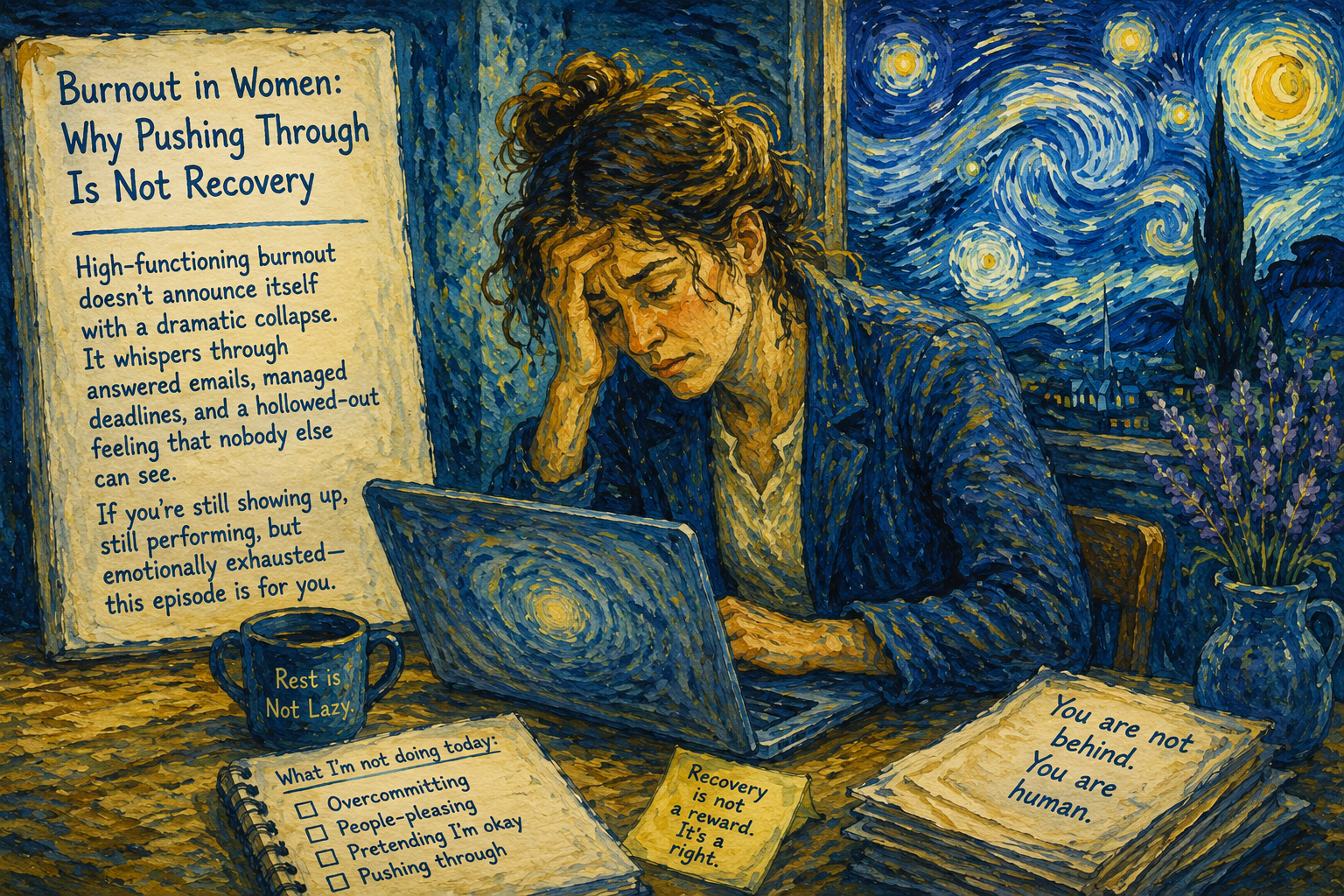
Burnout in Women: Why Pushing Through Is Not Recovery
Related Episode
Burnout in Women: Why Pushing Through Is Not RecoveryThe Invisible Crisis: High-Functioning Burnout
Here’s the thing about burnout in women that most people get wrong: it doesn’t always look like falling apart.
Sometimes it looks like answering emails at 3 AM. Sometimes it looks like remembering school forms, birthday cards, meeting notes, and the milk—all those small, invisible domestic tasks that somehow became your invisible infrastructure. Sometimes burnout looks like being capable, organized, reliable, and strong.
And yes, that’s lovely. Until it isn’t.
We call it “low maintenance,” and we mean it as a compliment. But what we’re really saying is: I’ve figured out that I can ask more and more and more of you without you pushing back. And so the asking continues. The demands compound. The recovery never comes.
This is high-functioning burnout, and it’s a particular kind of crisis because nobody around you realizes there’s a crisis happening at all.
The Performance That’s Costing You Everything
You’re still doing all the things. You’re still showing up. You’re still replying to emails, managing your team, swanning into meetings, hitting your targets. Professionally, you’re somehow still committed. But emotionally? You’ve left the building.
Privately, you feel hollowed out. You wake up tired. You go to bed even more tired. You can’t switch off properly. You feel guilty for needing to rest. You dread small tasks that used to be normal. And there’s this constant, grinding thought: If I stop, everything will just fall apart. I can’t stop. I have to keep pushing through.
Except here’s what we need to say out loud: pushing through is not recovery.
People see what you produce. They don’t see what it’s costing you. They see the polished email, but they don’t see the 3 AM. They see your calm meeting voice—the one you’ve been practicing for years—but they don’t see the tight jaw, the muscles in your stomach dropping, the breath that never quite settles. They don’t see that private moment in the car where going inside feels weirdly impossible.
Because you’re still functioning, everyone assumes you’re fine. Including yourself.
And that’s where the real damage happens.
The Muscle Analogy: Why Rest Days Aren’t Laziness
Think about physical training for a moment. Some of the fittest people at the gym are doing intensive routines every single morning, as if rest days were for amateurs. But here’s the thing: muscles don’t grow through constant output. Muscles grow during rest, during the recovery period.
If you train hard every day without repair, your performance drops. It’s just a matter of time. Your body gets stiff and cranky. Injuries start creeping in. Eventually, something has to give.
This is exactly what we expect women to do emotionally.
No rest days. No real recovery. No proper pauses. Just constant producing, caring, leading, absorbing, remembering, managing everyone else’s deadlines, moods, and preferences. And when the body starts protesting, we call it weakness.
It’s not weakness. It’s a system sending overdue invoices.
Your nervous system is not spare equipment. It’s your infrastructure. And if you’ve been running in high alert mode for too long, you cannot expect your body to recover because you had one bath or slept in until Sunday afternoon. That’s not a recovery plan. That’s like watering a plant once after keeping it in the cupboard for two years and then calling that horticulture.
Coping Is Not Healing
Here’s a critical distinction: coping is not the same as healing.
A weekend off? Lovely. A day to yourself? Wonderful. A walk in the park? Genuinely helpful. But temporary relief is not the same as restoration.
Relief says: I feel a little less awful.
Restoration says: My system is rebuilding capacity.
And capacity is the word we need here. Because burnout recovery isn’t just about resting more—though I wish it was that simple. It’s about rebuilding enough capacity so that your life is no longer draining you faster than you can recover.
That means looking at the whole picture:
- Your workload
- Your sleep patterns
- Your boundaries
- The emotional labor you’re carrying
- Perfectionism and people-pleasing patterns
- Role pressure and support systems
- Physical signals your body is sending
- The way you keep overriding yourself because stopping feels dangerous
It’s not about blaming you. It’s about telling the truth. Because burnout loves the fog. It loves vague language like I’m just tired or I’ll be fine after the weekend or I just need to get through this month.
Sometimes you do need to get through a rough week. But if every week becomes the week you’ve just had to get through, that’s not a busy patch. That’s a lifestyle that’s becoming hazardous for you and your body.
A Practical First Step: The Seven-Day Tracker
You don’t need an overhaul. You need information. And information gives you choices.
For the next seven days, track any burnout signals your body is giving you. Just once a day. Use these three headings:
Body — Notice any physical signals. Tense jaw. Tight shoulders. Shallow breathing. A weird stomach feeling. Headaches. Fatigue. Waking up wired. Your body wanting to sleep while your brain keeps going.
Mind — Notice one recurring thought pattern. Dread. Guilt. I can’t stop. I should be coping. I’m failing. Everything’s going to fall apart.
Behaviour — Notice one coping pattern. Saying yes to everything. Constant scrolling. Canceling things you need. Skipping lunch. Pretending you’re fine because it’s quicker than being honest.
Then ask yourself: The smallest thing that would reduce demand or increase support today is…
Answer honestly. Not perfectly. Not dramatically. Just truthfully.
It could be: Delay my reply to that email until tomorrow.
Or: Tell my partner I need 20 minutes alone before I start dinner.
Or: Book that GP appointment.
This isn’t about self-surveillance. It’s about making things visible. Because burnout thrives in vagueness.
The One Thing to Remember
You’re not broken. You’re not weak. You’re not deficient.
You’re depleted.
And there is a big difference.
You don’t need a dramatic breakdown before you’re allowed to take what your body is telling you seriously. Start early. Notice. Rest. Ask early. Adjust earlier. Document earlier.
Because recovery is required. Not because you’re failing. But because you’re a human being.
Ready to dive deeper into what high-functioning burnout really means for your life and nervous system? Listen to the full episode of Work Stress Anxiety to hear Cheryl’s complete insights, practical strategies, and the compassionate reality-first approach that can help you move from mere coping to genuine restoration. Every step you take toward recovery—no matter how small—is a step toward a brighter, more balanced future.