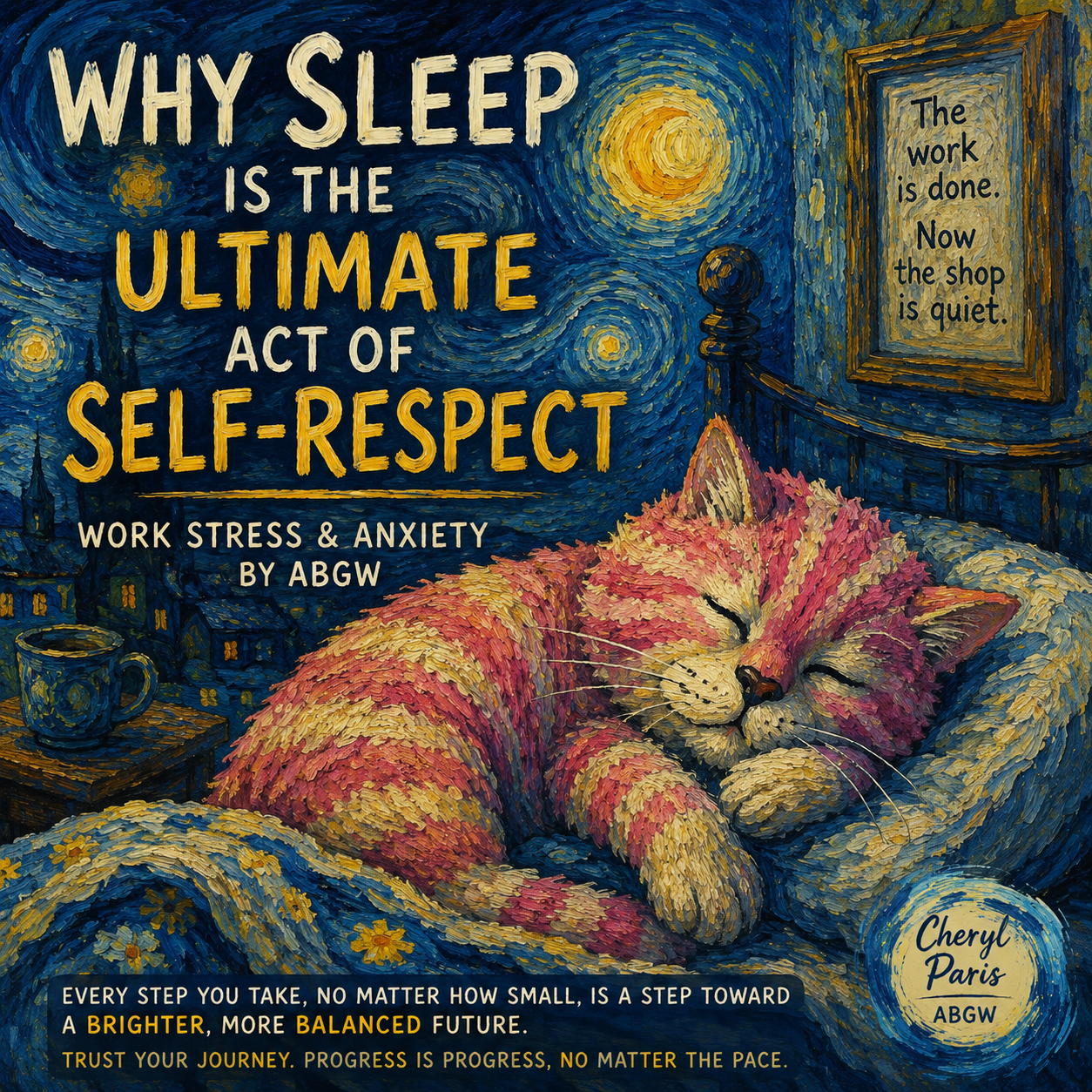
Why Sleep Is the Ultimate Act of Self-Respect
Related Episode
Sleep as Self-Respect | The Recovery Tool Burning Women OverlookYou know what fascinates me? We’ll spend hundreds of pounds on supplements, fitness watches, fancy mattresses, and blue light glasses. We’ll invest in magnesium sprays and white noise machines. We’ll do almost anything to improve our health. And yet, many of us treat one of the most powerful healing processes our bodies possess—sleep—like it’s optional.
If that contradiction has ever struck you as strange, you’re not alone.
Meet Ella: The Counsellor Who Forgot to Care for Herself
Let me introduce you to Ella. She’s 41, a talented counsellor who spends her entire day helping other people make sense of their emotions. Outside of work, she writes beautiful poetry, loves scuba diving (one of the few places where life finally becomes quiet), and enjoys ice skiing. She can balance beautifully on ice, but somehow, she struggles to find balance in her own evenings.
Every night starts with good intentions. “I’m going to have an early night,” she tells herself. Then an email arrives. A Teams notification pings. There’s one more load of washing to put on. A quick scroll. One more TV program. Just one more thing that has to get done for tomorrow.
Before she knows it, it’s nearly midnight.
The light goes out. Her body is desperate for sleep. But her brain has completely different ideas. It starts the night shift: Did you send that email? What about tomorrow? Should I have said something different? What if?
Sound familiar?
Ella isn’t unusual. She’s like most high-achieving women—incredibly good at looking after everyone and everything else, while quietly negotiating away her own wellbeing. And here’s the thing that makes me smile (not because it’s funny, but because it’s so achingly human): she desperately wants less stress, less anxiety, more patience, better concentration, and greater emotional resilience. Yet she treats the very thing that builds all of those qualities as something optional.
It’s like buying a beautiful plant and being surprised it dies because you watered it only when it was convenient.
The Bagpus Wisdom We’ve Forgotten
There’s a lesson in an old children’s character that I keep coming back to: Bagpus. Do you remember him? That pink, striped cat who ran the magic shop?
Bagpus never apologized for sleeping. He never looked guilty. When work was finished, he rested. When he was needed, he woke up fully and went to work. When work was done, he rested again. There was something wonderfully sensible about that rhythm.
Somewhere along the way, we decided that permanent exhaustion was admirable. People compete over it: “I only had four hours sleep last night.” “I answered emails until midnight.” “I’ve been awake since 5 a.m.”
Here’s the truth your nervous system wants you to know: it’s not handing out medals for that.
What’s Actually Happening While You Sleep
One of the biggest misconceptions about sleep is that nothing happens. We talk about it as though you simply “go to sleep” and that’s it.
Really?
Here’s what’s actually going on while you rest:
Your body is repairing tissue. It’s balancing your hormones. It’s strengthening your immune system. It’s taking all the events of the day and filing them into your memory. It’s regulating your emotions. It’s resetting your brain for tomorrow.
Sleep isn’t downtime. It’s one of your body’s busiest times—the time when everything it needs to work properly actually happens.
So when you cut sleep short, you’re not just losing rest. You’re interrupting the very system that makes patience, clarity, and resilience possible. You’re unplugging your fridge every night and then wondering why the milk keeps going off.
The Paradox of Self-Neglect
Here’s something I’ve always found fascinating: when we’re physically ill, almost no one argues about sleep. We cancel plans. We climb into bed. We trust that our bodies know what they need.
But when it’s only stress—when our nervous system is crying out for exactly the same thing—we suddenly stop listening. We push through. We stay up later. We do one more thing, answer one more email.
Why do we trust sleep when we’re physically unwell but treat it as an inconvenience when our nervous system is struggling?
We’ve confused self-neglect with commitment. We’ve decided that exhaustion equals caring. We admire the person who answers emails on holiday, who stays at work after hours, who says “I’ll sleep when I’m dead.”
(Here’s the thing about that last one: lack of sleep tends to make the second part arrive sooner.)
What True Respect Actually Looks Like
Instead of asking “How little sleep can I get away with?” perhaps we should ask: What kind of life becomes possible when I consistently respect my mind and body’s need for recovery?
These are completely different questions. One is about survival. The other is about living well.
Here’s a sentence I’d love for you to carry with you: Sleep isn’t an interruption to your life. It’s one of the ways your life quietly repairs itself.
Self-respect isn’t loud. It’s not those motivational posters everywhere. It’s not pretending you have everything together. Sometimes, self-respect is simply recognizing that your body has been carrying you all day and deciding it deserves recovery instead of another hour of emails.
That’s not weakness. That’s gratitude in action.
The Seven-Night Landing Strip Experiment
So how do we stop treating sleep like an inconvenience without turning bedtime into yet another impossible wellness routine?
Here’s my invitation to you: For the next seven evenings, create a small landing strip before bed. Just five minutes. No perfection required. No elaborate routine.
Five quiet minutes where you deliberately tell your nervous system the day is over.
Maybe that’s making tomorrow’s list. Maybe it’s reading a few pages from a book. Maybe it’s simply sitting quietly with a cup of tea. You’re not trying to force sleep. You’re preparing for recovery.
Remember this: The way you prepare for sleep says a great deal about the respect you have for the person you’ll be tomorrow.
Tomorrow’s version of you is quietly depending on the choices you make tonight.
The Real Question
We spend our lives trying to become more resilient, more patient, more creative, more emotionally balanced. Perhaps the answer isn’t doing more. Perhaps sometimes it’s about getting out of our own way—getting out of our body and mind’s way—and letting them do what they’ve evolved to do over generations.
Recover.
So tonight, instead of treating sleep as an inconvenience, treat it as one of the kindest conversations you can have with your future self.
Ready to explore this deeper? Listen to the full episode of Work Stress Anxiety to discover more about how sleep impacts your emotional resilience, hear Ella’s full story, and get practical strategies for protecting your recovery. Your future self is waiting.