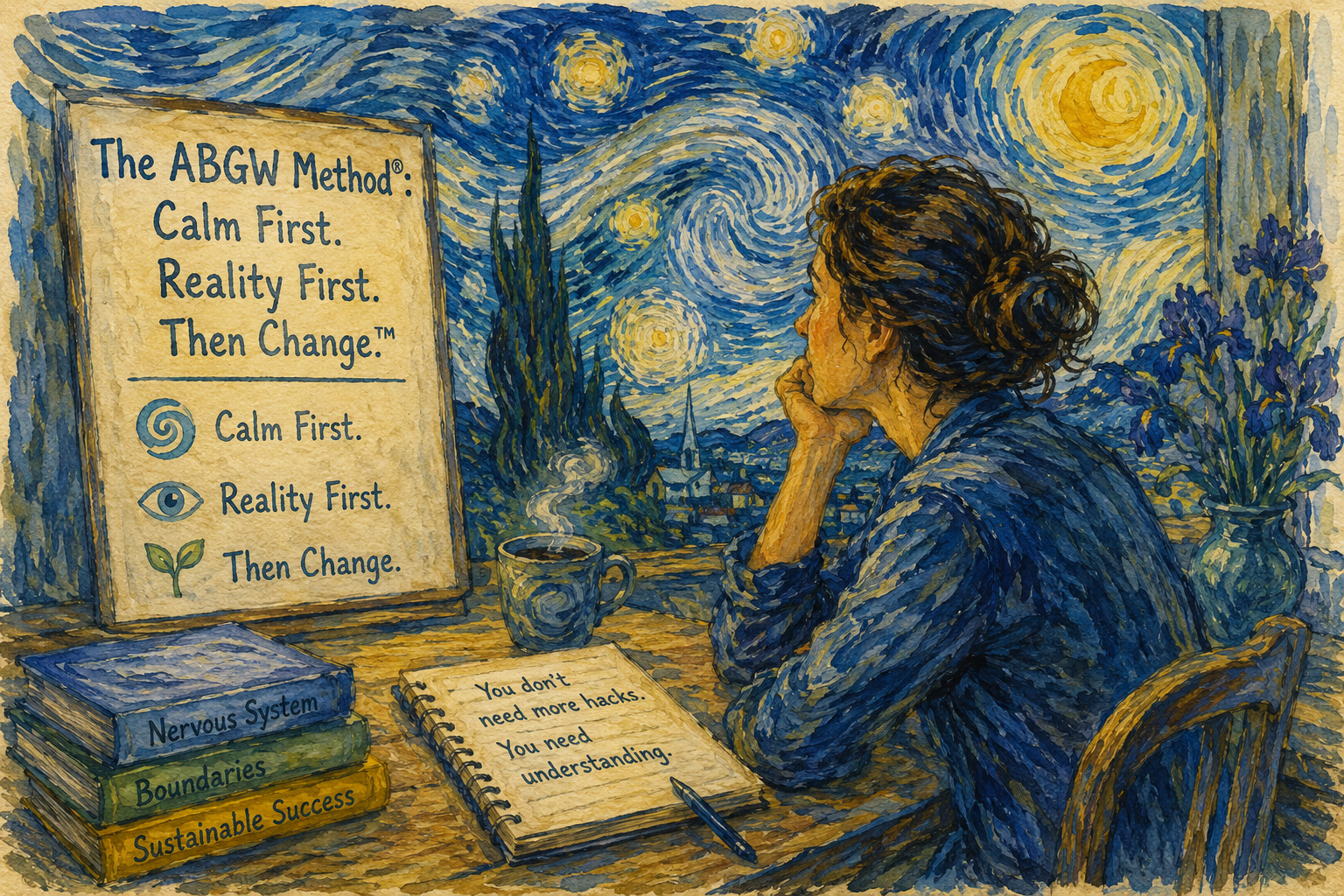
The ABGW Method®: Calm First. Reality First. Then Change.™
You’re Not Broken. Your Nervous System Is Just Tired.
Let’s start with the truth that most wellbeing advice conveniently skips over: knowing what you should do doesn’t automatically change anything.
You already know you need to rest. You know you should say no more often. You know you shouldn’t answer emails like they’re a newborn baby requiring immediate attention. You know you need to care a little less about other people’s chaos.
But here’s the thing—you’re living in reality, not a wellness Instagram post.
If you’re outwardly performing beautifully while privately running on fumes, or lying awake at night replaying meetings and rehearsing conversations, wondering why you can’t cope like you used to, then this episode—and this method—is for you.
Because let me tell you a secret: you are not broken. Your nervous system has probably just been doing night shifts for far too long.
The Gap Between Looking Fine and Actually Being Fine
There’s something Cheryl, the creator of the ABGW Method, has been fascinated by for years: the gap between what people look like when they’re coping and what they’re actually carrying.
You know this gap intimately, don’t you?
You can be functioning beautifully on paper—doing the work, keeping your diary up to date, answering messages, remembering everyone’s birthday, handling the crises, smiling at the right moment. And still feel like something inside you is being held together with really old sellotape.
Looking capable is not the same as being okay.
This is why the ABGW Method exists. It wasn’t created to tell overwhelmed women to become more resilient when the real issue is that they’re already holding too much. It came from a much more practical question: What problem are we actually trying to solve?
Or put another way: What perspective needs loosening right now?
Because when stress has you cornered, vague self-improvement isn’t helpful. You don’t need a new life by Friday. You just need enough steadiness to think clearly, enough reality to stop blaming yourself for everything, and one small change you’ll actually repeat.
How Work Stress Actually Shows Up (And Why You Don’t Notice It Until It’s Too Late)
For high-functioning women, work-related stress doesn’t announce itself politely. It sneaks in. It bursts. It looks like responsibility. It looks like being available, being the reliable one, being the one who says yes because saying no feels like pulling a pin out of a grenade.
It shows up as:
- Resentment
- A tight shoulder
- Poor sleep
- A feeling of dread in your brain
- A mental court case the moment it gets quiet
And here’s the part that really matters: work somehow doesn’t finish with you.
Your body is at home on the sofa, but your nervous system is still in the office. You’re making dinner, but part of you is thinking about tomorrow’s email. You’re brushing your teeth, and your brain decides that right now—just now—is the perfect time to revisit that conversation from three days ago and assess it for possible social, professional, and spiritual crimes.
This is where people often blame themselves. Why can’t I switch off? Why am I so tense? Why do I feel guilty for needing rest?
The answer isn’t usually because you’re weak. It’s because your nervous system has been trained by pressure, responsibility, lack of recovery, and workplace demands. The old survival strategies that used to work are staying on alert.
But here’s the hope: this doesn’t mean nothing can change. It just means the first step truly is not to bully yourself into being calmer.
The Four Pillars of ABGW: A Framework That Actually Works
The ABGW Method stands for Awareness, Balance, Growth, and Win-Win Well-being. Yes, it’s a mouthful—but Cheryl didn’t want a decorative acronym. She wanted a working structure.
Awareness: This Is Where I Am, Not Who I Am
Awareness means understanding your current state without turning your stress response into part of your identity.
“I’m anxious” is different from “My nervous system is active.”
“I’m failing” is completely different from “My capacity is overloaded.”
“I’m broken” is different from “I have been under too much pressure for too long.”
This distinction matters because it gives you language without pathologizing your experience. You’re not broken—you’re responding normally to abnormal pressure.
Balance: It’s Really About Capacity
Balance doesn’t mean becoming a serene woodland creature who never loses her keys. Balance is about honest capacity checks.
It means asking:
- What is my real bandwidth here?
- What am I asking my body, mind, and emotions to carry?
- Where am I pretending I have infinite energy because everyone else finds that convenient?
This is where we stop confusing self-care with scented candles and start talking about actual recovery. Real balance includes micro steps, sleep protection, calendar boundaries, fewer automatic yeses, and more honest conversations with yourself about what you can actually carry.
Growth: Tiny Experiments, Not Heroic Overhauls
Growth in ABGW is not a punishment program. It’s experimentation, exploration, and discovery.
Not tests. Not heroic overhauls. Not new year, new me nonsense that lasts two days.
Just tiny experimentation: one boundary sentence, one pause before saying yes, one evening when you don’t open your laptop, one moment where you notice your stress patterns without turning it into a character assassination.
Win-Win Well-being: Progress Without Collapse
Win-Win Well-being means your wellbeing improves without your life burning down to make it happen.
It means looking for changes that protect your nervous system, your dignity, your relationships, your work, and crucially, your future choices.
It’s calm with a backbone.
The Mental WD-40 Moment: Your Micro Step for Today
Here’s a practical tool you can use right now. Cheryl calls it the “Mental WD-40 moment” because stress patterns are sometimes like a rusty lock. If you attack it, yank it, swear at it, and demand it opens immediately because you have things to do, you’ll probably just hurt your hand.
But if you loosen it first, something changes.
The next time you notice a familiar work stress pattern, try this:
1. Catch it and name it. Keep it factual. Is it overthinking? Saying yes automatically? Feeling guilty for needing rest?
2. Anchor your body. Bring yourself into the present moment. Notice your feet on the floor. Roll your shoulders back one centimeter. This signals to your nervous system that everything is okay.
3. Shift slightly. Ask yourself: What is one thing I can loosen right now?
Maybe you write down the thought instead of arguing with it. Maybe you say to yourself, “Let me come back to you about that.” Maybe you choose to sleep on it.
That’s the WD-40 moment—a small loosening.
Relief Now, Restoration Over Time
There’s an important distinction here: relief is not the same as restoration.
Relief is when the pressure drops a little. You breathe out. You stop spiraling for a moment. You feel less alone. Relief matters.
But restoration is deeper. Restoration is when those small moments start becoming familiar. You notice stress earlier. You stop mistaking guilt for truth. You stop treating your body’s signals like inconvenient noise, and you begin to trust yourself again.
The ABGW Method is interested in both—relief now and restoration over time.
Because nobody needs another method that sounds clever but only works for imaginary people with no calendars and no dependents.
Start Here: Calm First. Reality First. Then Change.
If you’re dealing with work stress, work anxiety, burnout, overthinking, or that wired-but-exhausted feeling after work, don’t start by demanding a full life transformation.
Start smaller. Start steadier. Start here.
Calm first. Create the conditions where calm becomes possible.
Reality first. Understand what’s actually happening without judgment.
Then change. Make small, repeatable experiments that actually fit your life.
Because awareness asks, “What is happening?”
Balance asks, “What capacity do I actually have?”
Growth asks, “What small experiment can I try?”
And Win-Win Well-being asks, “How do I move forward without abandoning who I am?”
That’s the method. It’s not magic. It’s not fluff. It’s a calm way back to choice.
Your Next Step
Before you go, ask yourself this: What is the one work stress pattern I don’t need to solve today, but could start to spray that WD-40 on?
Remember—progress is progress, no matter the pace.
Ready to dive deeper into the ABGW Method and discover how to reclaim your calm and clarity? Listen to the full episode of Work Stress Anxiety by ABGW to hear Cheryl’s complete insights, real-world examples, and additional tools for managing work stress. And if this episode resonates with you, please follow the podcast and share it with someone who needs to hear that they’re not broken—they’re just tired.
Your journey towards balance begins with the smallest of steps.