How to Measure Progress When You're Exhausted: Redefining Success Beyond the Performance Review
Related Episode
Burnout Recovery | How to Track Wins When You're DrainedThere’s a quote on my wall that’s become deeply important to me, and I want to share it with you today because I think it might change how you measure your own progress.
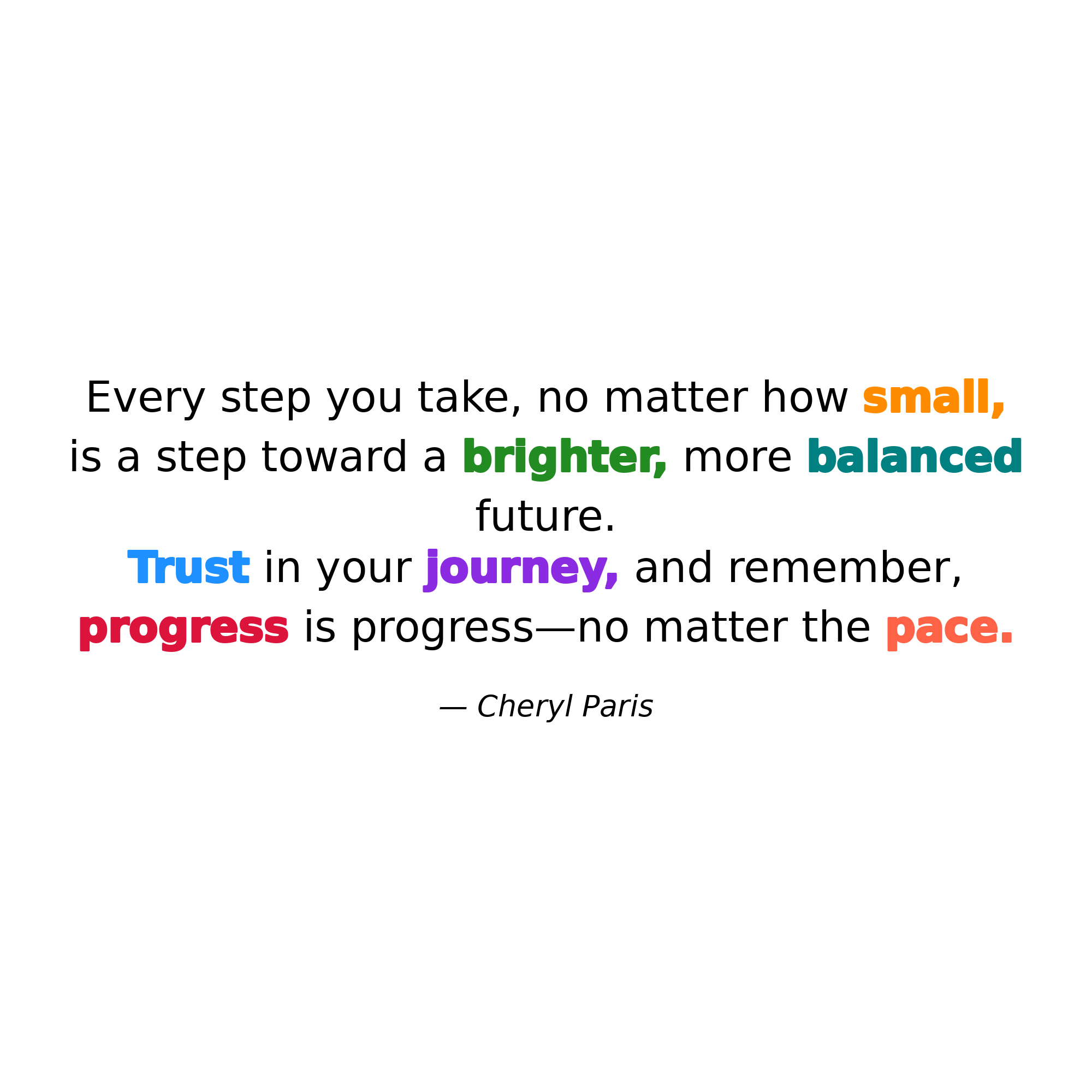
Every step you take, no matter how small, is a step towards a brighter, more balanced future. Trust in your journey and remember, progress is progress no matter the pace.
On the surface, it sounds like the kind of motivational thing you’d nod politely at—maybe see on a mug somewhere. But it’s nothing of the sort. And if you’re anything like Allie, a capable, encouraging 51-year-old who loves karaoke, music festivals, and coaching grassroots football, you might have initially thought it was nice but slightly bonkers.
Here’s the thing though: Allie kept listening. And gradually, she realized this wasn’t a gimmick. It was serious. It wasn’t telling her to push harder, stay positive, or keep going when every part of her was exhausted. It was offering her—and everyone else—a completely different way of measuring progress.
When Recovery Becomes Another Performance Review
If you’re dealing with work stress, anxiety, emotional exhaustion, or burnout, you already know what it feels like to believe you’re falling behind. You think you should be coping better, sleeping better, setting stronger boundaries, feeling calmer, and ideally solving everything by Thursday afternoon.
Then the wellness advice arrives. Another morning routine. Another breathing technique. Another app to track. Another habit to master. And suddenly, you’re not just recovering from burnout—you’re failing at recovery too.
This is where that quote matters so much.
Because here’s what I’ve noticed: a step doesn’t have to be dramatic, visible, or impressive on your social media feed. It might be admitting, “I’m not actually okay with what’s happening.” It might be recognizing, “I’m quite angry about that.” It might be leaving an email until tomorrow, taking a proper lunch break, asking for help, or going to bed instead of trying to solve another problem.
When you’ve experienced severe distress, the smallest meaningful step might be telling one trusted person the truth.
Small doesn’t mean insignificant. Sometimes, the smallest step is the largest step a person has the emotional, mental, or physical capability to take in that moment. And that matters.
The Power of Acknowledging What You Actually Feel
I was reminded of this recently when something happened and I felt angry. But here’s what I did: I told myself I shouldn’t be angry. Maybe upset. Possibly disappointed. But angry? Apparently, my internal committee rejected that application.
And here’s the thing—refusing to acknowledge the anger didn’t make it disappear. It made it more entrenched. I was dealing with the original situation and fighting with myself about how I was allowed to feel about it.
But the moment I acknowledged, “I am genuinely angry,” something shifted.
Not because the anger vanished, but because I stopped wasting energy arguing with its existence. Then I could ask better questions: Why am I angry? Did something feel unfair? Was a boundary crossed? What does this emotion need me to recognize? What would an appropriate response actually look like?
Here’s what’s crucial: acknowledging an emotion doesn’t mean acting on every impulse attached to it. Accepting that you’re angry doesn’t mean shouting at someone. Recognizing anxiety doesn’t mean letting anxiety make every decision.
It’s about awareness.
Awareness simply allows you to say, “This is what is happening inside me.” And once you can see and experience what’s happening, you have a better chance of responding consciously instead of reacting automatically.
The ABGW Method: Transforming Stress Into Sustainable Wellbeing
This is at the heart of what I call the ABGW Method®. It doesn’t ask, “How do we get rid of stress and anxiety?” Instead, it asks a more productive question: How can we transform the energy within stress and anxiety into awareness, balance, growth, and more sustainable wellbeing?
We all know stress is part of being human. In appropriate amounts, it helps us focus, act, and respond. The problem begins when it becomes chronic or overwhelming—when it stops helping us respond and starts controlling how we’re living.
The aim isn’t to become a permanently calm robot. That’s where balance comes in.
Balance asks something useful: What can I realistically do now? What support do I need? What can wait? What is the smallest sustainable step? Sometimes balance means taking action. Sometimes it means resting. Sometimes it means waiting until you’re calmer before making a decision.
You can burn yourself out trying to recover from burnout. This is real. It happens when capable people recognize years of overworking, people-pleasing, and poor boundaries, then decide their entire life must be renovated within a week.
Progress for Allie might not begin with leaving her job or producing a color-coded recovery plan. It might begin with noticing she’s carrying the whole week into football training, then giving herself ten quiet minutes in the car before she steps onto the pitch.
That pause won’t repair an entire unhealthy workplace. But it may help her notice what belongs to this moment, what belongs to work, and what she doesn’t want to pass on to the people she’s coaching.
Then comes growth—not about becoming more impressive, but about deciding who you are now. It’s about learning from your experiences, recognizing your values and patterns, and making choices aligned with the person you want to be.
And finally, wellbeing—caring for other people without sacrificing yourself, and caring for yourself without disregarding everyone else.
Progress Isn’t Linear, and That’s Okay
When I say “a step towards a brighter, more balanced future,” I’m not promising perfection or a life without stress, anxiety, or difficult emotions.
The word towards matters. You do not have to have arrived.
You can be moving towards something and still have difficult days. You can be making progress and fall into old habits. You can be growing and still feel uncertain. Growth has no certainty whatsoever.
Progress isn’t neat, visible, or a straight line. Sometimes it’s setting boundaries. Sometimes it’s realizing you’re not ready yet. Sometimes it’s having a difficult conversation. Sometimes it’s deciding not to have that conversation while you’re emotionally overwhelmed. Sometimes progress is stopping long enough to check whether the direction you’re moving still belongs to you.
And pace is not a measure of worth. People don’t begin from the same place. They don’t have the same health, responsibilities, financial concerns, support, or life experiences. A step that appears tiny to one person might require tremendous courage from someone else.
The useful question isn’t: Am I moving as quickly as someone else?
It’s: Am I moving in a direction that supports my wellbeing, my values, and my actual life?
Transform Emotion Into Information
One of the most powerful tools I’ve found is journaling. It helps create space between emotion and reaction. I might write, “I am angry.” Then, “What am I angry about?” Then, “What needs to be acknowledged?” Eventually, “What response would allow me to respect myself tomorrow?”
The journal doesn’t force the emotion to disappear. What it does is transform emotion into information. And that’s what we’re trying to do with stress and anxiety—not erase it, not deny it, not turn ourselves into permanently serene creatures who float above difficult meetings.
We’re trying to understand it well enough to use its energy more constructively. To move from distress towards useful action. From paralysis towards purposeful living. From automatic reaction towards conscious response.
That’s when something magical happens. That’s when what I call outrageous unconscious joy becomes possible—not false positivity, not pretending life is easy, but genuine joy that emerges when we’re no longer spending so much energy fighting ourselves.
One Question for You
So here’s what I want to leave you with: What is one step you’ve taken recently that you haven’t given yourself true credit for?
Perhaps you recognized a feeling sooner. Perhaps you said no, paused, rested, or asked for support. Perhaps you simply became more aware of something you couldn’t previously see.
Don’t dismiss your step because it was small. Small does not mean meaningless. Small doesn’t mean stuck. Progress doesn’t stop being progress simply because it arrived quietly.
If this episode shifted how you think about stress, anxiety, and progress, listen to the full episode to dive deeper into Allie’s story, practical journaling techniques, and how to build sustainable wellbeing that actually fits your real life. Follow Work Stress Anxiety and share this with someone who needs permission to notice their progress.