Burnout on the Horizon? Why Tapping Could Help You Pause Before Stress Takes Over
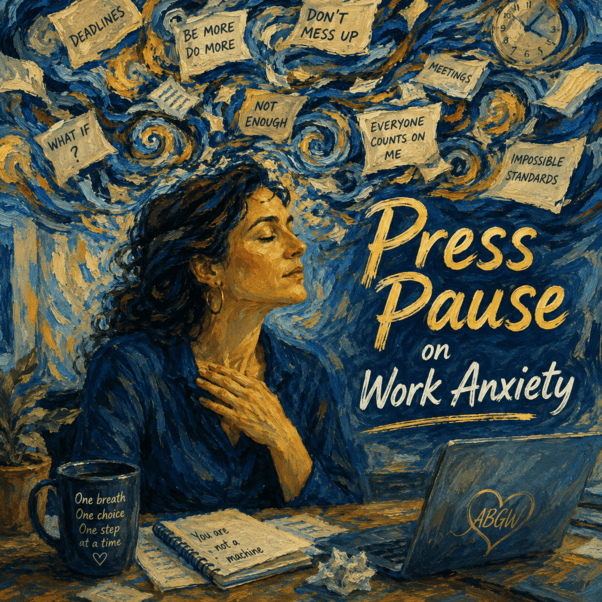
You’re sitting at your desk. Your heart is racing. Your mind is spinning. And you’re trying—desperately—to look like everything is fine.
If this sounds familiar, you’re not alone. And you’re definitely in the right place.
Today, we’re talking about something that might seem a bit unconventional at first glance: tapping. Not the kind you do on your keyboard, but Emotional Freedom Technique (EFT)—a blend of ancient wisdom and modern neuroscience that’s backed by over 300 peer-reviewed studies.
I know what you might be thinking. Tapping? Really? It sounds too simple, maybe even a bit silly. But here’s the thing: when you understand what’s actually happening in your brain and body during a stress spike, tapping stops sounding like wishful thinking and starts sounding like nervous system regulation. Which is exactly what we need.
What Is EFT Tapping, Really?
Let’s break this down in the simplest way possible.
EFT tapping is actually a combination of three different healing approaches working together at the same time:
1. Energy Therapy (Acupressure Without the Needles)
Think of traditional acupuncture. Instead of needles targeting your body’s energy meridians and acupressure points, you’re using the gentle percussion of your fingertips to tap on these same points. Same principle. Different tool.
2. Cognitive Therapy (Talk Therapy That Matters)
As you tap, you’re actively speaking about what you want to release. You’re naming the stress, the overwhelm, the anxiety. This isn’t just venting into the void—it’s giving your tapping an extra boost of power and intention.
3. Somatic Therapy (Getting Out of Your Head, Back Into Your Body)
This is the piece that often gets overlooked but is absolutely crucial. Somatic therapy brings your energy back down into your body and into the present moment. Instead of catastrophizing about the future or replaying past conversations on an endless loop, you’re anchored in now—where, truthfully, everything is usually fine.
When these three elements work together, something remarkable happens.
The Biology Behind the Calm
Here’s where it gets really interesting.
When you experience stress—whether it’s a critical email from your boss, a challenging team meeting, or just the general weight of your workload—your amygdala (the stress center in your brain) gets triggered. Often, you won’t even consciously know why it’s triggered. You just know you feel anxious, overwhelmed, or panicked.
In that moment, your body floods with cortisol, the stress hormone. Your nervous system essentially believes your life is in danger and prepares you to fight, flee, or freeze.
Here’s the problem: your prefrontal cortex—the part of your brain responsible for logical thinking, sound decision-making, and emotional regulation—goes offline. You literally cannot think straight until you calm down that amygdala.
This is why “just calm down” or “think rationally” never works in the moment. You can’t access those rational parts of your brain while your threat-detection system is in overdrive.
But when you tap on those acupressure points while acknowledging your stress, something shifts. Research shows that tapping removes cortisol from your body 43% faster than doing nothing at all. Your heart rate lowers. Your blood pressure decreases. Your immune system response actually improves.
And crucially—your amygdala gets the message: You’re safe. It’s okay to calm down now.
The One-Minute Desk Tapping Sequence You Can Use Right Now
Here’s what makes EFT so practical for high-achieving women navigating work stress: you don’t need a quiet room, 30 minutes, or anyone’s permission. You can do this at your desk, and honestly, if you’re a fidgeter like most of us, nobody even needs to know you’re doing it.
The Points (in order):
- Eyebrow point — Right at the beginning of both eyebrows
- Side of eye — At your temples
- Under eye — On your cheekbones
- Under nose
- Under mouth — Between your nose and chin
- Collarbone point — Go down about an inch from where your collarbone begins; there’s a soft valley there
- Top of head
The Words (as you tap through):
Start at your eyebrow point and say: “I feel so stressed right now.”
Move to your temple: “For whatever reason…”
Under your eye: ”…or for a million reasons.”
Under your nose: “And I feel this stress in my body [name where], and I don’t know how to let it go.”
Then here’s the crucial part: “But I want to honor that I have this feeling, because it’s there for a good reason. My body is trying to protect me. My nervous system sees something as a threat. And I want to remind myself: I am okay in this moment. Nothing is outwardly dangerous. It’s okay to feel safe and calm. It’s okay to let this stress go.”
Keep cycling through these points, repeating this sequence for as long as you have. Even one minute makes a difference.
The Key: Honour, Don’t Fight
Here’s something that might feel counterintuitive, and it’s why skepticism is so common around EFT:
You’re not trying to make the stress go away by ignoring it or pushing it down. You’re leaning into it.
For 90 seconds, you’re asking yourself to feel the stress. Really feel it. Notice where it lives in your body. Is it a tightness in your chest? A constriction in your throat? A knot in your belly? You’re not judging it or criticizing yourself for having it. You’re acknowledging it.
And here’s the magic: the moment you lean into it with acceptance instead of resistance, it starts to lose its grip on you. The intensity decreases. Your nervous system gets the signal that you’re safe enough to process this emotion, and it begins to move through you instead of getting stuck.
This is the opposite of what we’ve been taught our whole lives. We’ve been taught to hide uncomfortable emotions, to put on the brave face, to show only the shiny, happy parts of ourselves. But emotions that don’t get processed don’t disappear—they get stored in your body and demand attention later.
The Research Speaks for Itself
If you’re still skeptical (and honestly, that’s fair—tapping does look a bit silly), the numbers are hard to argue with.
A recent study conducted at an EFT training measured participants before and after just four days:
- Anxiety decreased by 40%
- Depression decreased by 35%
- PTSD symptoms decreased by 43%
- Physical pain decreased by 57%
- Cravings decreased by 74%
- Happiness increased by 31%
These aren’t small shifts. These are significant, measurable changes—without medication, without invasive procedures, without anything other than your fingertips and a few minutes of your time.
The Bottom Line
Burnout doesn’t announce itself with a formal invitation. It creeps in quietly—through the 2 a.m. wake-ups, the racing thoughts during meetings, the feeling that your success has become too expensive.
But you don’t have to wait until burnout arrives to take action. EFT tapping is a tool you can use right now, today, at your desk, to pause before stress takes over.
It’s simple. It’s backed by science. And it actually works.As an EFT specialist myself, I was especially keen to explore this with Amy in a grounded, practical way for people dealing with work stress, anxiety and emotional overwhelm.
Ready to learn more about how EFT can transform your relationship with work stress? Listen to the full episode with Amy Vincze on the Work Stress Anxiety podcast. You’ll get deeper insights into the neuroscience, more advanced tapping sequences, and the answers to questions you didn’t even know you had.
Your nervous system will thank you.